Art Painters Names the Great Wave Off Kanagawa Maker
No one wants to exist at body of water and come across a neat wave about to crash onto them, toppling their boat. This is the moment the Japanese artist, Katsushika Hokusai, has printed in time. Now well-nigh 200 years quondam, The Great Moving ridge painting is still "making a splash" and there have been thousands of reproductions and prints. We will explore this famous Japanese art example in the commodity below.
Tabular array of Contents
- one Artist Abstract: Who Was Katsushika Hokusai?
- 2 The Great Wave off Kanagawa past Katsushika Hokusai In Context
- 2.one Contextual Assay: A Brief Socio-Historical Overview
- 3 Formal Analysis: A Cursory Compositional Overview
- 3.i Subject Matter
- 3.ii Color
- 3.3 Perspective and Scale
- four "Just Another Five More Years"
- v Frequently Asked Questions
- 5.1 When Was The Great Wave off Kanagawa Made?
- 5.2 Where Is The Great Wave off Kanagawa?
- 5.3 What Is The Great Moving ridge off Kanagawa Pregnant?
Artist Abstract: Who Was Katsushika Hokusai?
Katsushika Hokusai was a Japanese Ukiyo-e painter, he was born on Oct 31, 1760, in the Katsushika city in Edo, Nippon. Some sources land that his proper noun was Kawamura Tokitaro, however, he evidently changed his name thirty times during his career every bit an artist. He grew up around artistry and began painting when he was around six years quondam.
He worked for a woodcarver during his teenage years and studied at Katsukawa Shunshō'southward studio where he learned about Ukiyo-e woodblock press; he was expelled from this school too. He became a well-known artist throughout Japan and Europe. He was married twice and had several children, one of which, named Oi, also became an artist. He apparently produced approximately 30,000 prints during his fine art career.
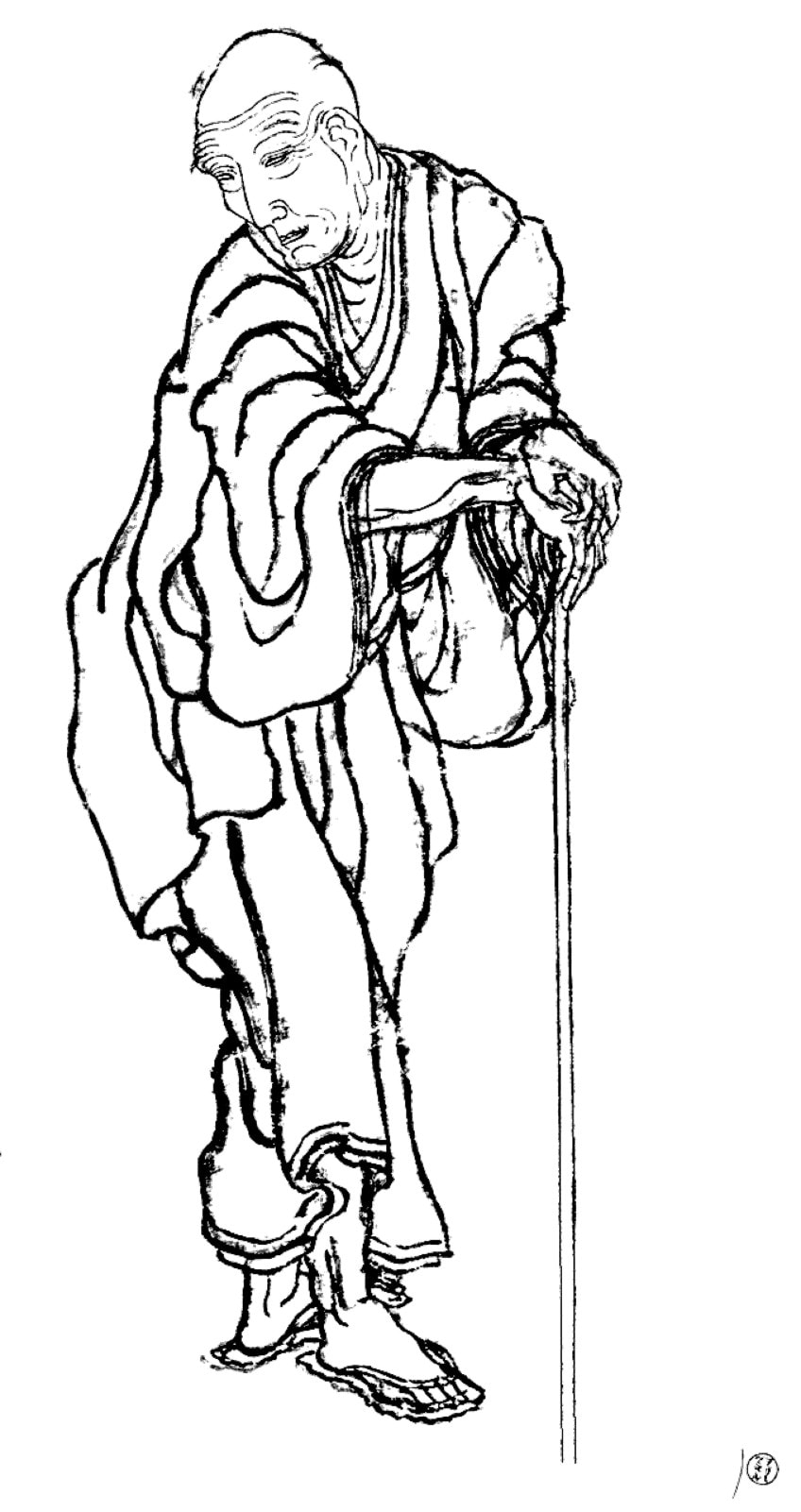 Self portrait equally an one-time man (unknown date) by Katsushika Hokusai;Katsushika Hokusai, Public domain, via Wikimedia Commons
The Groovy Wave off Kanagawa by Katsushika Hokusai In Context
In Japanese, it is titled Kanagawa oki nama ura, which translates to "Under the Wave off Kanagawa". This is the famous wave painting by Japanese artist Katsushika Hokusai, titled The Great Wave off Kanagawa in English. The painting is also dubbed every bit only The Great Wave.
Below we will discuss a brief contextual assay of The Great Wave painting, answering questions like "When was The Not bad Wave off Kanagawa made?", which was during the Edo period in Japan, also every bit how it fits into the Hokusai paintings and his series of 36 paintings about Mount Fuji.
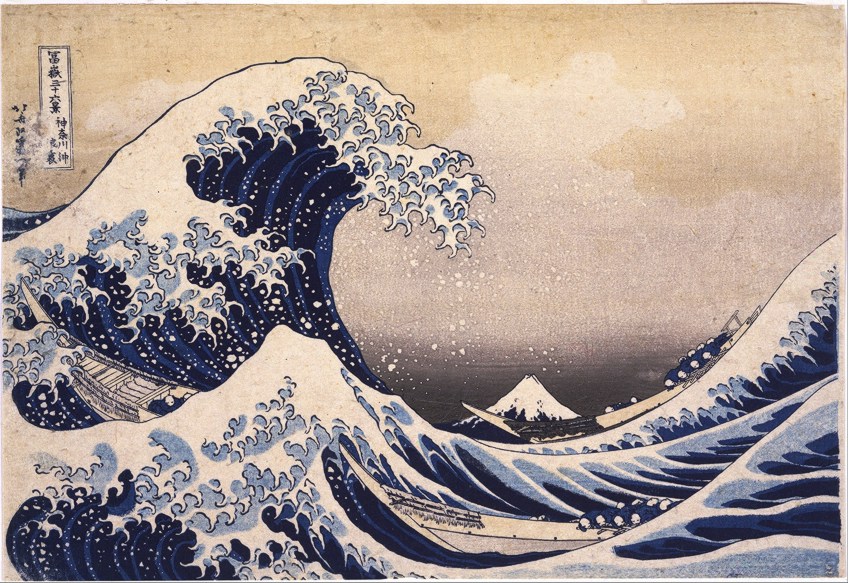 The Neat Wave off Kanagawa (c. 1830-1832) past Katsushika Hokusai;Katsushika Hokusai, Public domain, via Wikimedia Commons
We volition and then provide a formal analysis, discussing the wave painting in more detail by looking at the discipline thing and various stylistic elements similar coloring, perspective, so forth, all of which characterizes this famous Japanese art way, which is the woodblock impress.
| Artist | Katsushika Hokusai (1760 to 1849) |
| Date Painted | c. 1830 to 1832 |
| Medium | Polychrome woodblock print, ink and colour on paper |
| Genre | Ukiyo-e woodblock impress, Landscape art |
| Menstruum / Move | Edo period in Nippon (1603 – 1867) |
| Dimensions | 25.seven x 37.8 centimeters (around 10 x 14 inches) |
| Series / Versions | Part of the Thirty-Six Views of Mount Fuji series |
| Where Is It Housed? | The Metropolitan Museum of Art (MET), New York, U.s. |
| What It Is Worth | Estimated worth around millions of dollars |
Contextual Analysis: A Cursory Socio-Historical Overview
The Edo menstruum in Japan was between 1603 to around 1867. Information technology was under the rule of the Tokugawa shogunate, which was the form of regime during that fourth dimension, which was based in the capital Edo, now called Tokyo. During this time in Japanese history, there was more stability in economics and society, nonetheless, there were besides stricter regimes and rules.
Society was also structured into different classes; it started with the emperor and the nobility, then information technology was the samurai, peasants, craftsmen, and merchants, respectively.
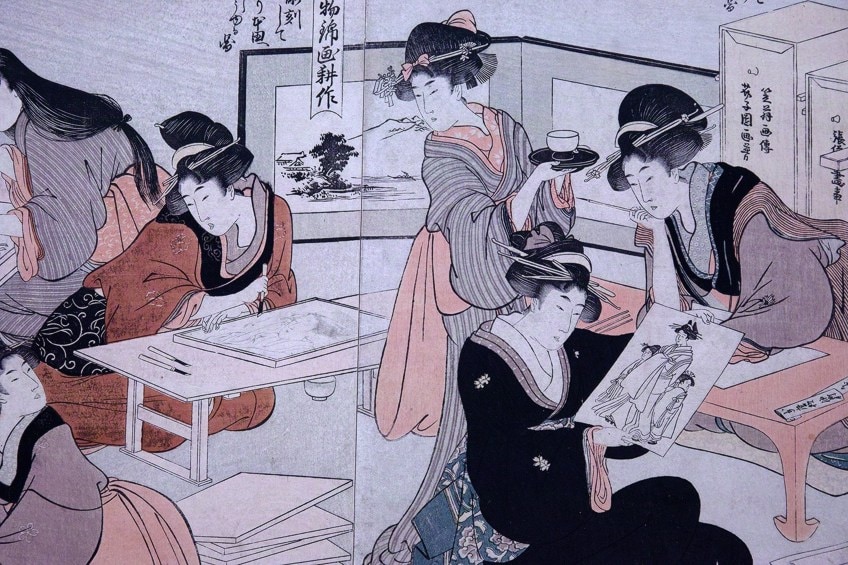 A painting by Kitagawa Utamaro (1754 – 1806) depicting the woodcut-making process. In this panel, the artist shows the publisher (behind the desk-bound) the woodcut draft. In the center is a servant with tea; ArishG, CC By-SA 3.0, via Wikimedia Commons
With the increased stability and peace in society, there was also more than production of the arts, and information technology has often been described as a catamenia where people enjoyed the arts and a variety of fields of entertainment. This new exploration of the sensual and sexual was called Ukiyo, significant "floating globe".
There was a greater sense of taking pleasure in various aspects of life, for example, the Kabuki theatre, Geishas, which were female entertainers and dancers, Sumo wrestling, literature and poetry, Japanese puppet theater (Bunraku), and various aspects related to sexual activity, pleasure, beauty, and beloved.
What Are the Ukiyo-e Prints?
The Ukiyo-e prints became a genre of fine art during this menstruum of Japanese history. It was in the course of paintings and woodblock prints that centered effectually the indulgences and enjoyments from the Ukiyo urban civilization. It depicted scenes and figures from all sorts of arts and entertainment.
However, this genre as well developed over time and included different subject matters, which included landscapes, nature, and animals. We see the focus on landscapes in the Hokusai paintings.
The unlike types of subject field thing, in more detail, consisted of the Bijin-ga, meaning and referring to images of "beautiful women". This would ofttimes include famous women or courtesans, and those of celebrity status. In that location was also Shunga, pregnant "pictures of Spring", however, the word "Jump" in this case was another term for sexual activity.
Other types included Yakusha-e, meaning "actor prints" which were of famous actors from the Kabuki theater; Kachō-ga meaning "flower and bird paintings/prints", which would consist of bailiwick matter from nature.
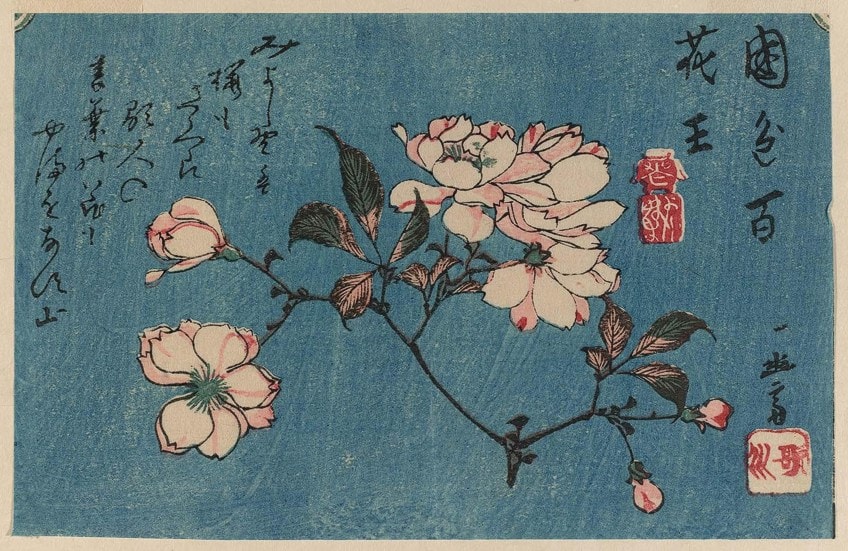 A Kachō-ga painting of cherry blossoms and birds by Utagawa Hiroshige;Utagawa Hiroshige I, Public domain, via Wikimedia Commons
Ukiyo-e is the Japanese term that translates to "pictures of the floating world" in English language. However, this term has another meaning fastened to the Buddhist beliefs about the transience of life. It referred to sorrow or sadness about life and the cycle involving decease and rebirth. Sources country that uki means "sadness" and yo means "life".
The term Uki meant "to float" when it was used within the context of the Edo menstruation and all the cultural proliferation. Information technology is easier to understand why the Ukiyo-e prints were so prominent because they depicted not the fleetingness of life and death equally the Buddhists believed, but the fleetingness of lifestyles and desires.
Hokusai: The Importance of Waves and Mount Fuji
Hokusai made a wave painting series depicting dissimilar views of Mount Fuji. It was chosen Xxx-Half dozen Views of Mountain Fuji (c. 1830 to 1832); in Japanese, this series was chosen Fugaku sanjurokkei. The Not bad Wave painting is the first impress from this in a higher place-mentioned series.
Still, this is not Hokusai's offset exploration with waves in his paintings.
In three examples from his earlier paintings, he includes the oceanic wave and its stylistic details, namely Springtime in Enoshima (1797), View of Honmoku off Kanagawa (1803), and Fast Cargo Boat Battling the Waves (1805). In all three of these Hokusai paintings, the moving ridge features in its characteristic scroll.
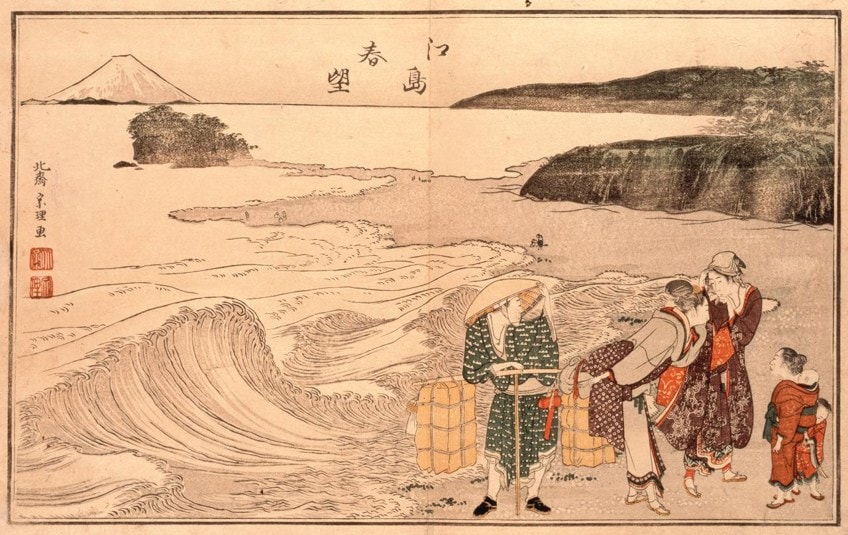 Springtime in Enoshima (1797) by Katsushika Hokusai;Katsushika Hokusai, Public domain, via Wikimedia Commons
Springtime in Enoshima was believed to have been inspired by the painting A View of Seven-League Beach (1796) past Shiba Kōkan, a Japanese artist who also painted during the Edo period and created Ukiyo-eastward prints. He used the pseudonym "Suzuki Harushige", although he besides worked nether other names.
In Kōkan's painting, there are two figures to the right on the beach and the sea wave to the left ebbs onto the shore. We run into this wave curl appearing larger in Springtime in Enoshima. Similarly, the wave is as well depicted to the left, about about to crash onto the shore where there are several figures continuing.
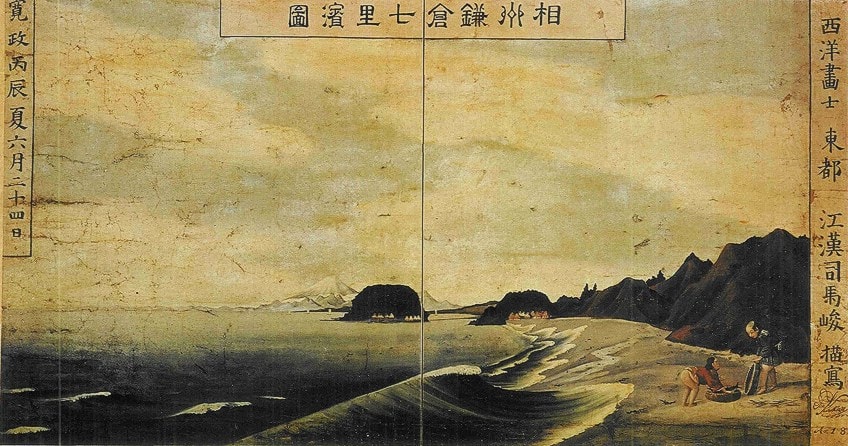 A View of Seven-League Embankment (1796) past Shiba Kōkan;Shiba Kōkan, Public domain, via Wikimedia Eatables
In the latter ii Hokusai paintings mentioned to a higher place, at that place are boats on the ocean, and they navigate through the overwhelmingly large waves swaying them about. In View of Honmoku off Kanagawa, at that place are two boats nearly to seemingly crash into the large embankment to the left. It is important to note the vantage bespeak, which appears from the side view and almost at eye level.
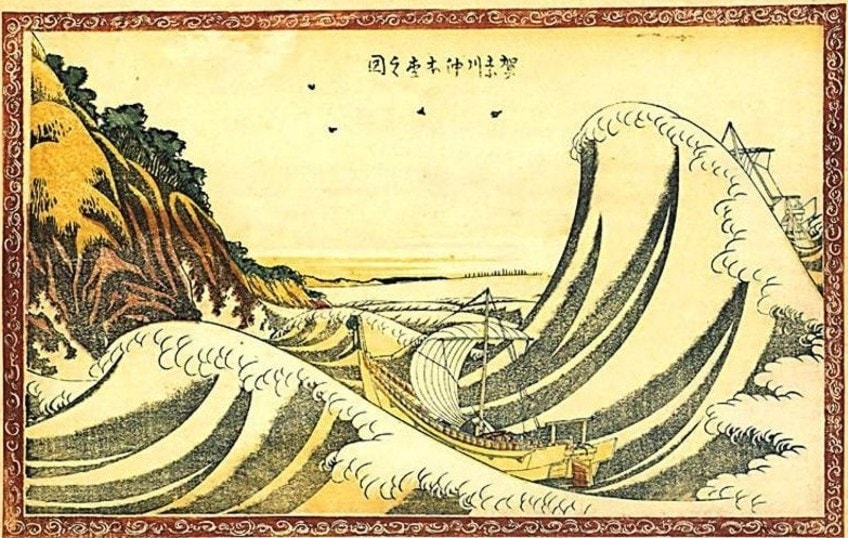 View of Honmoku off Kanagawa (1803) past Katsushika Hokusai; Katsushika Hokusai, Public domain, via Wikimedia Eatables
In Fast Cargo Boat Contesting the Waves, we meet a boat with several figures in it struggling confronting the sheer steepness of the wave they are on. There are 2 other visible boats in this composition, all seemingly in their own struggle with the surrounding waves.
The vantage point in this painting is more from an aerial viewpoint, which heightens the dramatic effect.
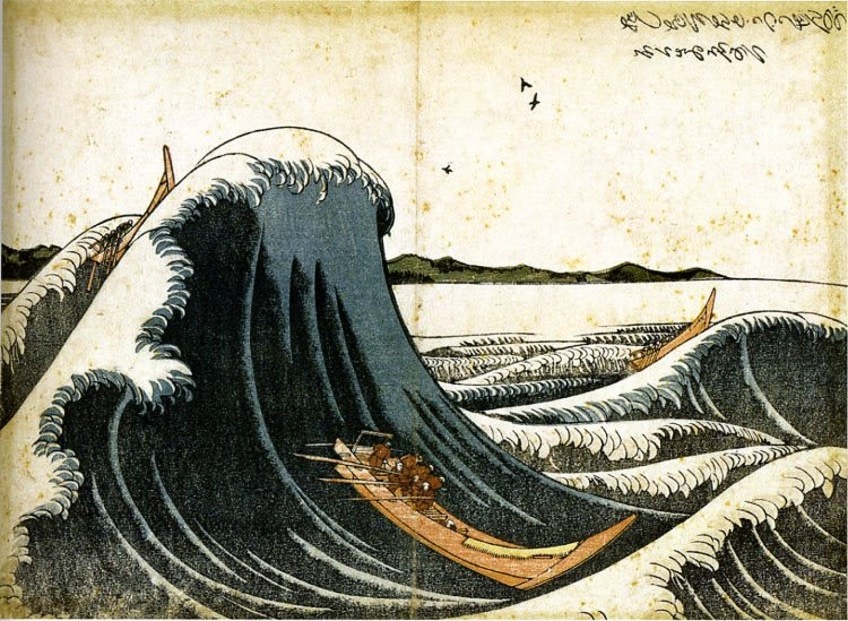 Fast Cargo Gunkhole Contesting the Waves (1805) by Katsushika Hokusai;Katsushika Hokusai, Public domain, via Wikimedia Eatables
These are important stylistic elements mentioned above, ones which we will discuss every bit part of The Great Wave off Kanagawa meaning below. We will explore the perspective Hokusai chose to piece of work with also every bit how this influenced numerous other artists who lived in Europe at the time.
When looking at Hokusai's Thirty-Six Views of Mountain Fuji serial., we will see that he is ultimately focusing on Mount Fuji, giving u.s.a. diverse vantage points of the famed Japanese mountain. In The Cracking Wave off Kanagawa, Katsushika Hokusai makes Mountain Fuji visible through the big impending waves.
Mount Fuji is on Japan's main island, named Honshu. It is Nihon's highest mountain, over 12,000 anxiety high. It is also an active volcano. Mount Fuji is not only whatever mountain, equally it held a deeper meaning for both Hokusai and the Japanese culture, deeming it a sacred mountain.
 Red Fuji, or Fine Wind, Clear Morning (c. 1830) past Katsushika Hokusai; Katsushika Hokusai, Public domain, via Wikimedia Commons
Throughout Japan's history, Mount Fuji was a site for pilgrimages and various deity venerations. Information technology still is a site where people can hike and encounter its wonders. Information technology has as well been the main subject matter for various art forms, including famous Japanese arts that were produced as souvenirs for those who loved the mountain, whether seeking information technology out for pilgrimages or equally a tourist attraction.
From Nihon to Europe: Japonism
The Ukiyo-e prints became widespread pieces of fine art that were also affordable for many in Japan. During the nineteenth century, the prints came to America and Europe, which was because of opening trade betwixt the West and the E. These famous Japanese art pieces became widespread pieces of art for many European artists nosotros are all familiar with today. This also started the movement, or trend, called Japonism, or Japonisme in French.
Japonism included a broad variety of Japanese arts and designs and was frequently appropriated from the perspective of the West. It was considered an "exotic" art style.
The Impressionist and Postal service-Impressionist fine art movements were amid the art styles that drew considerable inspiration from Japanese art, especially the Ukiyo-e woodblock prints. Some examples of artists included the Impressionists like Claude Monet and Edgar Degas; some of the Post-Impressionists included Vincent van Gogh, Paul Gauguin, Henri de Toulouse-Lautrec, and many others.
A famous example includes van Gogh'southward painting Bridge in the Rain (Afterwards Hiroshige) (1887) painting after the original Ukiyo-e woodblock print past Utagawa Hiroshige called Sudden Shower over Shin-Ōhashi bridge and Atake (c.1856 to 1859).
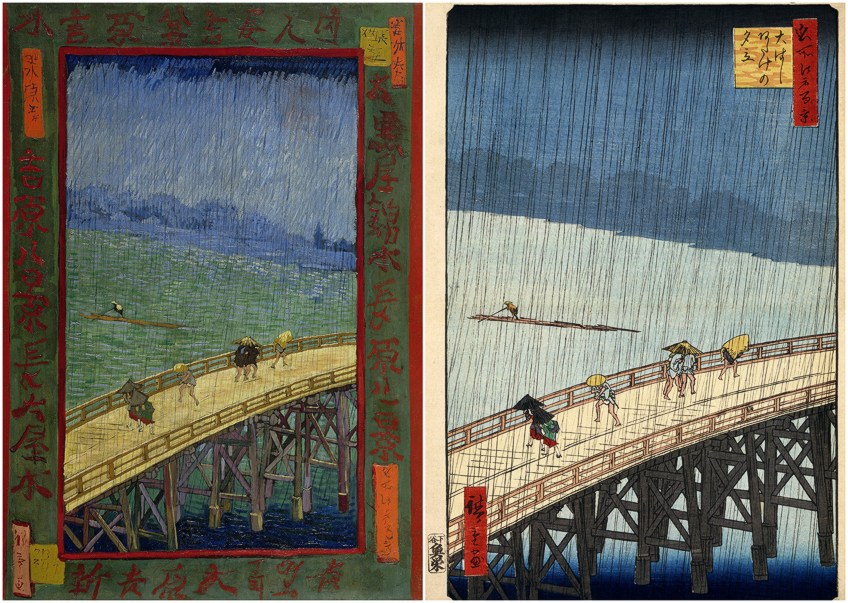 LEFT: Span in the rain (after Hiroshige) (1887) by Vincent van Gogh; Vincent van Gogh, Public domain, via Wikimedia Eatables | Right: Sudden shower over Shin-Ōhashi bridge and Atake (1857) by Utagawa Hiroshige; Utagawa Hiroshige, Public domain, via Wikimedia Eatables
At that place were also artists from the Art Nouveau fashion who loved the increasingly famous Japanese art, Gustav Klimt was among them. The art dealer from Germany, Siegfried Bing, was among one of the kickoff to introduce Japanese art in Europe and this, in turn, influenced Klimt'south piece of work besides.
He imported diverse Japanese arts and sold them in Paris.
He was also known to take pioneered the Art Nouveau style in Paris and published Le Japon Artistique (1888 to 1891) journal each month, which explored various Japanese objects and arts. He as well exhibited and sold Japanese objets d'art in his gallery Maison d 50'Art Nouveau. Bing'due south active interest in procuring Japanese art and objects aided in its broadcasting in the West.
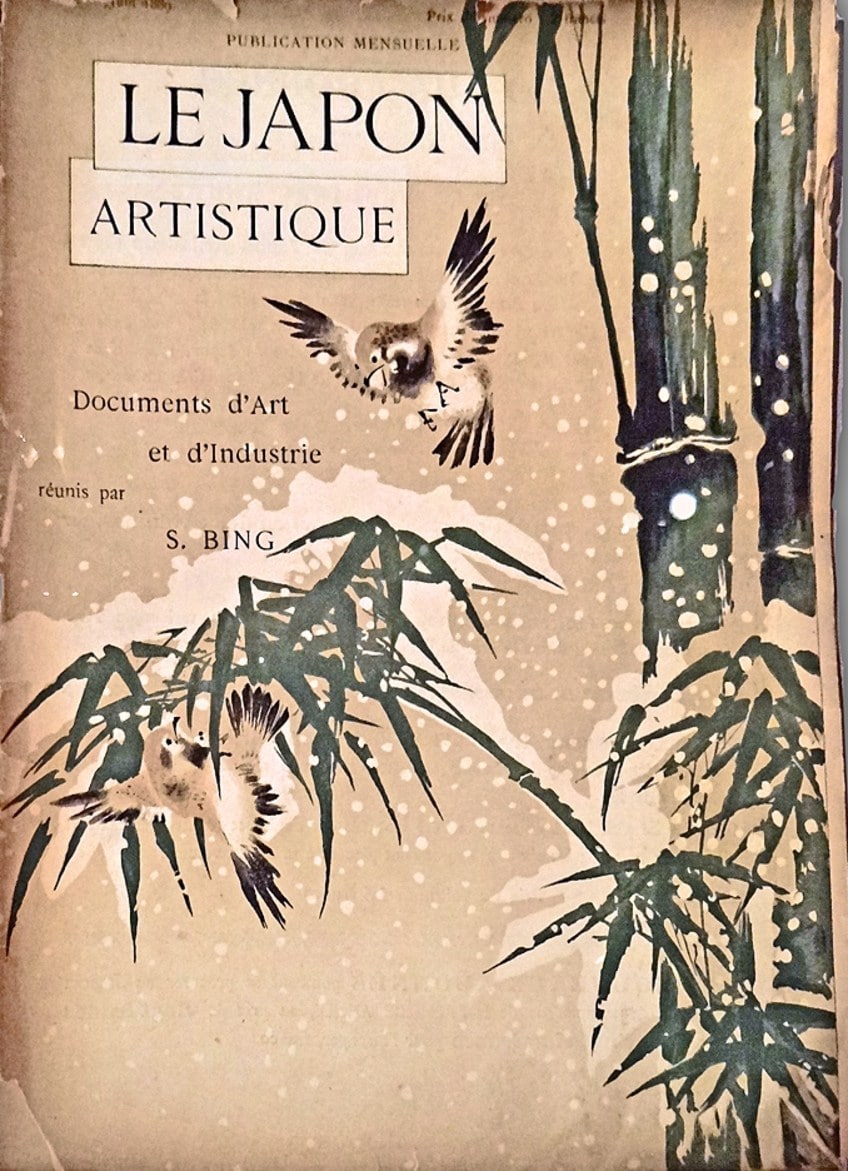 Le Japon Artistique journal;Jean-Pierre Dalbéra from Paris, France, CC BY two.0, via Wikimedia Commons
Hokusai's serial Thirty-Half dozen Views of Mount Fuji also influenced other artists like the French Henri Rivière who created his lithograph series chosen 36 Views of the Eiffel Tower (1902). Hokusai was also an influence on Edgar Degas, who reportedly and endearingly stated that the Japanese artist is "not merely one artist amongst others in the Floating Earth. He is an island, a continent, a whole globe in himself".
Formal Analysis: A Brief Compositional Overview
Beneath we await at The Great Wave painting by Hokusai in more than item. At present that we have more agreement of the traditions around this Japanese wave painting and where it came from, we will explain how some of its features correlate with the stylistic characteristics of Ukiyo-e woodblock prints from Nihon.
Subject Thing
This famous Japanese art Ukiyo-e impress has been viewed via its three main subject matters, namely, the undulating and dominating sea, the three boats, and the view of Mount Fuji far in the distance. In The Great Moving ridge off Kanagawa Katsushika Hokusai depicts a big, looming, moving ridge coming in from the left-hand side of the composition.
The moving ridge's size composes nearly of the left side and fills upward what seems to be a gray or flossy colored sky, the wave's white foamy tips also seemingly double as white clouds in the sky.
The tips of the great moving ridge almost appear similar small white claws coming to take hold of hold of the men in the boats. While this description does non exercise this print justice, it hints at the enormity and power inherent in the wave and the fragility of the men in the three boats.
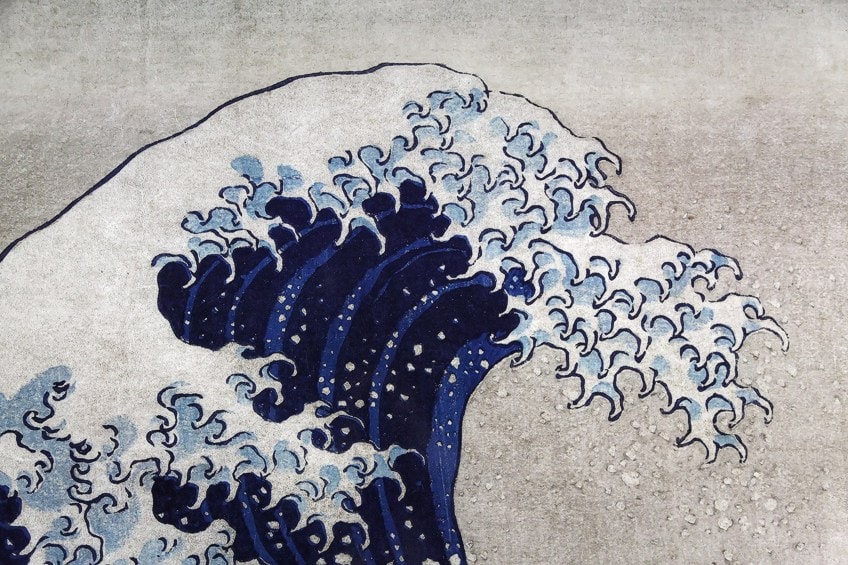 A particular of The Great Wave off Kanagawa (c. 1830-1832) by Katsushika Hokusai; Frank Vincentz, Public domain, via Wikimedia Commons
We will also see smaller waves filling upward the foreground. At that place is a sweeping sway of the water from left to right and right to left, giving dynamism and dramatism to the scene. What will happen to the men in the boats? Hokusai captures a moment just before the massive wave will hit.
Let united states of america look at the three boats; there appear to be two in the foreground and i closer to the background.
There are viii rowers in each boat likewise as what seems to be two people nigh the front side of the boat. All the figures are similarly clothed in night blue, which matches the blue of the water just beneath them. The boats are referred to as oshiokuri-bune boats, which were utilized in Nippon for fishing.
 Details of the men in boats in The Great Wave off Kanagawa (c. 1830-1832) past Katsushika Hokusai. LEFT:
HokusaiHokusai, Public domain, via Wikimedia Eatables | MIDDLE: Hokusai , Public domain, via Wikimedia Commons | RIGHT: Hokusai, Public domain, via Wikimedia Eatables
We volition notice that nestled in the distance, opposite our gaze, is the snow-capped Mount Fuji. This besides suggests that Hokusai painted the scene during Winter. The mountain has a properties of greyness skies behind it and around it, which farther suggests a storm or that this was painted during the forenoon light, as some sources advise. There are more white clouds in the sky equally we direct our gaze closer to the foreground.
Some sources also indicate out that the white tips of the great wave, which are directly higher up the tip of Mountain Fuji, could turn into snow that falls onto the mount'south height. This also shows usa how Hokusai'due south utilise of perspective offers dissimilar interpretations.
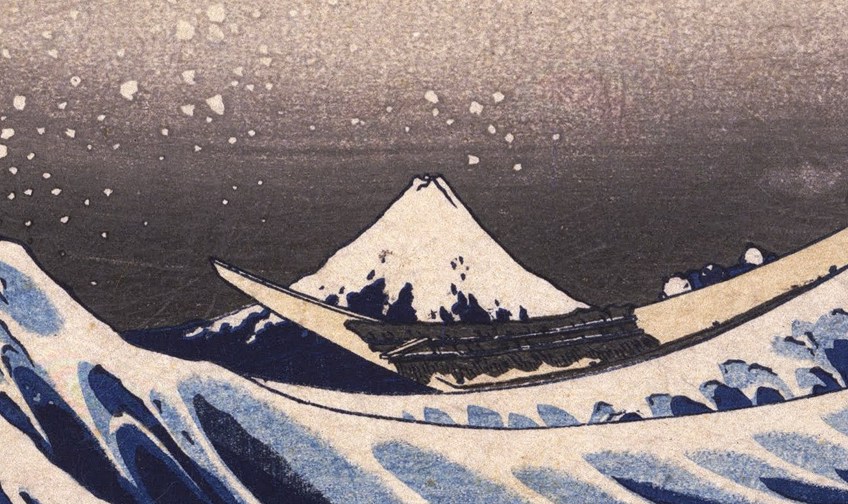 Mount Fuji in The Great Wave off Kanagawa (c. 1830-1832) by Katsushika Hokusai;Katsushika Hokusai, Public domain, via Wikimedia Commons
You may likewise be asking, "Where is The Corking Wave off Kanagawa"? The title gives us a inkling, existence "off Kanagawa", which is one of Japan's prefectures around the region chosen Kantō in Honshu, which, as we mentioned before, is the primary island of Nippon. This question can also have a double meaning; in instance you wondered where the print is at present, it is housed at the Metropolitan Museum of Art in New York City.
To the left-hand edge of the print, there are two vertical signatures or inscriptions in traditional Japanese script, peradventure Kanji.
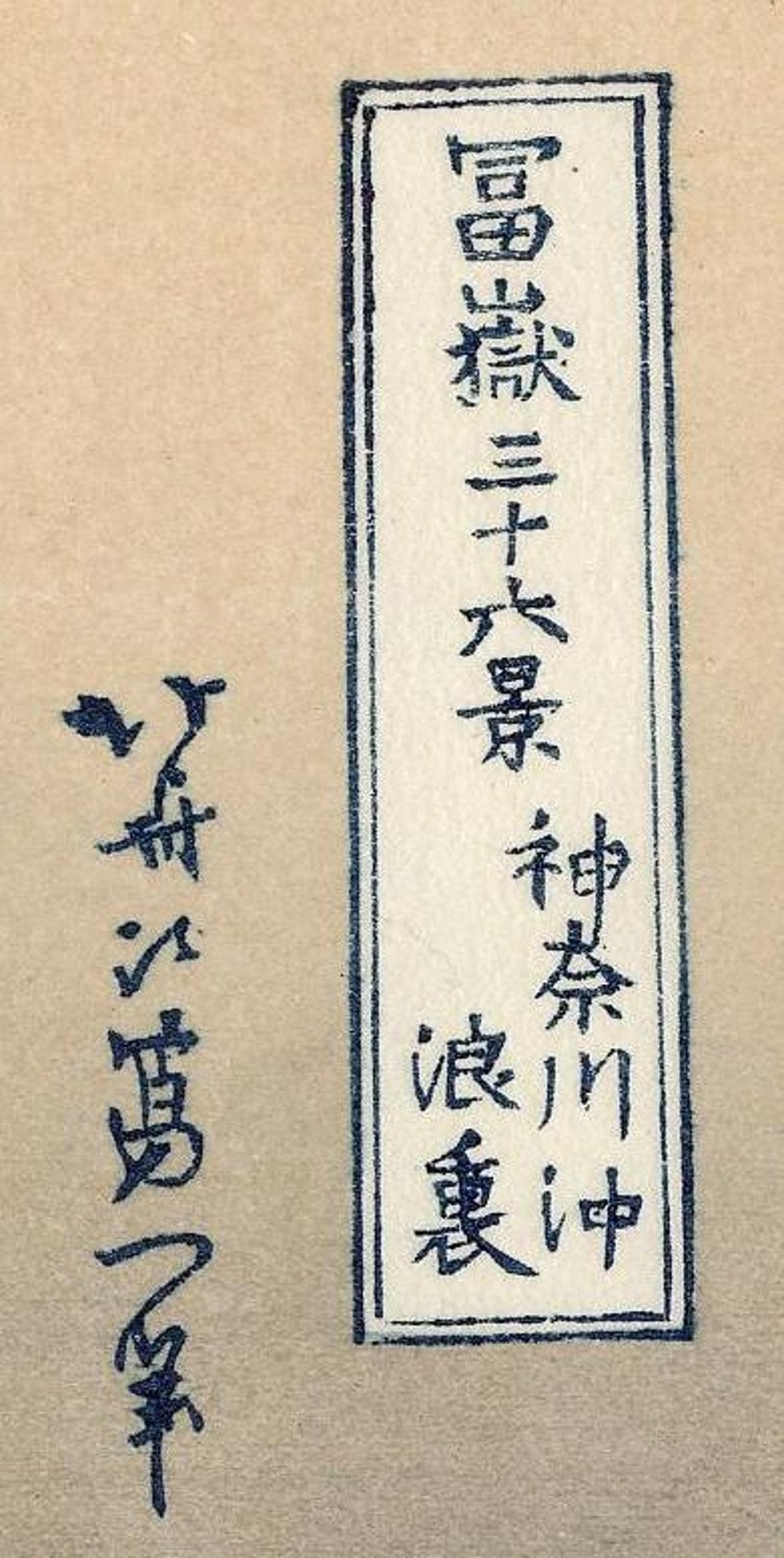 A detail of the script in The Dandy Moving ridge off Kanagawa (c. 1830-1832) by Katsushika Hokusai; Hokusai Katsushika, Public domain, via Wikimedia Commons
The inscription to the far-left states Hokusai'southward name and has been translated equally, "Hokusai aratame litsu hitsu, meaning "From the brush of Hokusai, changing his proper name to litsu". Apparently, Hokusai frequently likewise inverse his name, which would explain why the inscription states that he is changing his name to "litsu".
The inscription with the surrounding edge is the title of the print. Information technology states Fugaku Sanjūrokkei / Kanagawa oki / nami ura, pregnant "Thirty-6 Views of Mountain Fuji / Offshore from Kanagawa / Beneath the wave".
Color
In The Great Moving ridge off Kanagawa Katsushika Hokusai utilized various shades of blues. This has been a notable feature of this famous Japanese fine art woodblock print, but also of the overall series, 30-6 Views of Mount Fuji. There was a specific colour, called Prussian blueish, that Hokusai reportedly utilized in his prints. This was reportedly discovered after scientific studies were done on Hokusai'due south print.
Prussian blue was besides called "Berlin blueish" and was plain discovered by the Berlin pigment maker, Johann Jacob Diesbach in 1706.
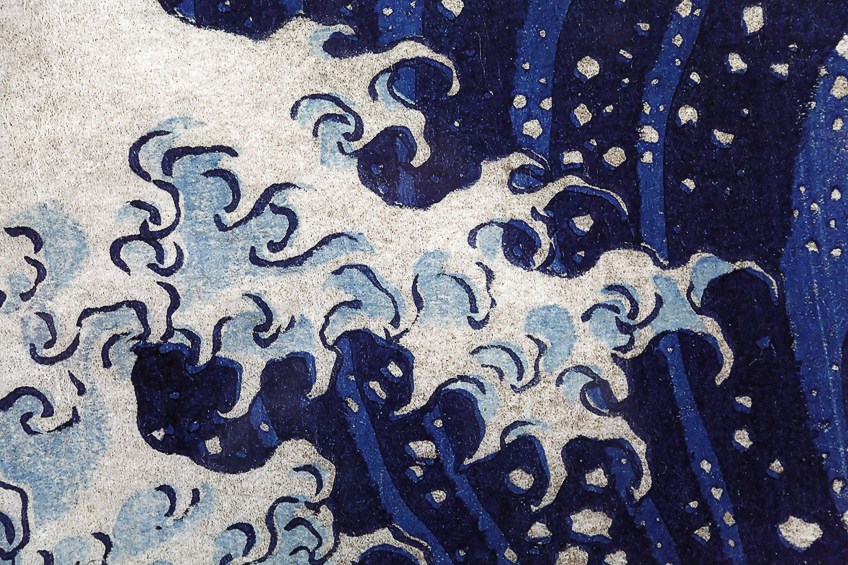 The use of colour in The Nifty Wave off Kanagawa (c. 1830-1832) by Katsushika Hokusai; Frank Vincentz, Public domain, via Wikimedia Commons
Prussian blue was also imported from Europe and reportedly there was a keen need for it when Hokusai created his famous wave painting. This was a synthetic blue that lasted longer and did not fade as quickly.
Perspective and Scale
If we await at the perspective and calibration in The Great Wave painting, we will find that it points united states to a lot of the characteristics related to perspective and how Japanese artists utilized space in their Ukiyo-e prints in general. Hokusai presents the states with a scene that appears from a semi-aerial vantage point. We, the viewers, are situated at an unknown viewpoint that seems to exist slightly elevated giving us this bird'southward eye view.
Still, simultaneously, Hokusai also places us at more of a level vantage point, virtually as if we too are on a gunkhole viewing the impending crash from the groovy moving ridge. We besides see Mountain Fuji straight opposite our gaze.
The perspective is further highlighted by how Hokusai utilized line and motility. Our gaze is continuously pulled by the current of curving motions created from the waves in front of the states. And every bit our gaze swirls, we eventually arrive at the smaller depiction of Mountain Fuji in the distance. This creates depth within the composition, giving it that dynamic iii-dimensional quality. It likewise indicates Hokusai's exploration of contrasting spatial aspects of something closely viewed and far away.
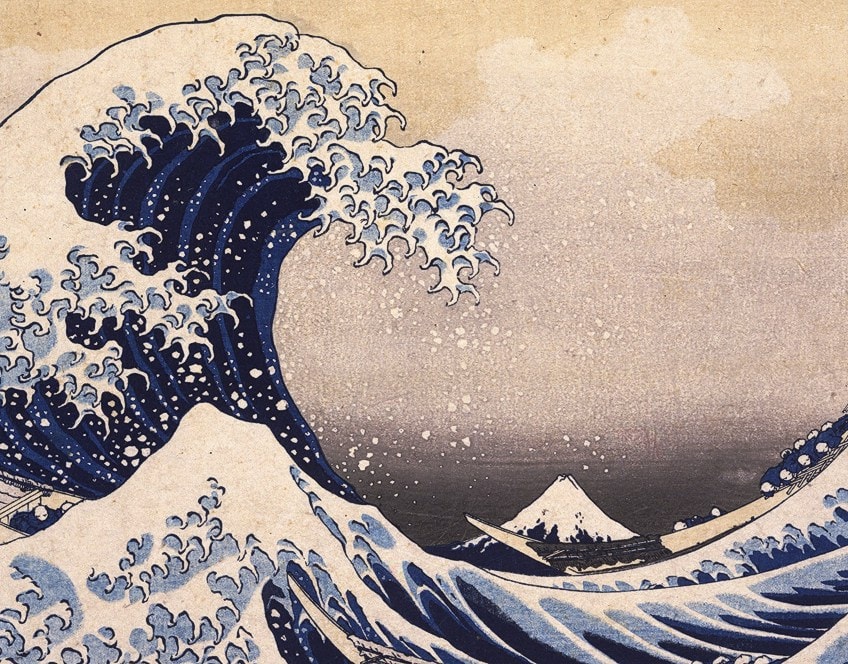 Perspective in The Great Moving ridge off Kanagawa (c. 1830-1832) by Katsushika Hokusai;Katsushika Hokusai, Public domain, via Wikimedia Commons
Information technology is also of import to note that Hokusai was also influenced by Dutch and French copper engravings, which inspired his techniques to include European styles of linear perspective.
We also see how Hokusai plays on different geometric shapes and lines in The Smashing Moving ridge painting, from the beautiful curving wave in the foreground to the smaller triangular shape of Mount Fuji in the background. There is a potent diagonal rhythm from the way the waves are painted, but likewise a horizontal rhythm from the boats in the water. The boats, although playing on the horizontal, equally play on and echo the curves from the water and waves.
"Just Another Five More Years"
This is reportedly what Katsushika Hokusai said on his deathbed; he died in 1849. He wanted more years equally an artist and is widely quoted past many sources equally saying, "If only heaven will give me only another ten years…But another v more years, then I could become a real painter".
Whatever Hokusai may have believed nigh his abilities every bit an artist, whether he felt he was not good enough or needed more exercise, he certainly imprinted his artworks in the memories of many artists when he was alive and after his death to the present time.
Frequently Asked Questions
When Was The Cracking Wave off Kanagawa Fabricated?
The Great Wave off Kanagawa was painted during the Edo menses in Nihon, which spanned between the 1600s to 1800s. It is estimated to have been made and published effectually 1831. Information technology was a part of Hokusai'due south series of paintings titled Thirty-Six Views of Mount Fuji (c. 1830 to 1833).
Where Is The Great Wave off Kanagawa?
The Keen Wave off Kanagawa print is housed at the Metropolitan Museum of Fine art (MET) in New York City, United States. Other reproductions and prints are housed at dissimilar institutions worldwide.
What Is The Smashing Wave off Kanagawa Meaning?
When nosotros look at The Great Wave off Kanagawa significant and inherent symbolism information technology could point to the thought of nature and human and these contrasting forces. The men in the boats seem to exist in a losing battle against the sheer force and ability we run across in the magnitude of the wave about to crash over them.
Belum ada Komentar untuk "Art Painters Names the Great Wave Off Kanagawa Maker"
Posting Komentar