what two factors led to the end of the long drives

Cattle drives were a major economic action in the 19th and early 20th century American West, particularly betwixt 1850s and 1910s. In this period, 27 1000000 cattle were driven from Texas to railheads in Kansas, for shipment to stockyards in Louisiana and points east. The long distances covered, the need for periodic rests by riders and animals, and the establishment of railheads led to the development of "cow towns" across the borderland.
Due to the all-encompassing treatment of cattle drives in fiction and motion-picture show, the equus caballus has become the worldwide iconic image of the American West, where cattle drives still occur.[1]
Move of cattle [edit]
Cattle drives represented a compromise between the desire to get cattle to marketplace equally quickly as possible and the demand to maintain the animals at a marketable weight. While cattle could exist driven every bit far every bit 25 miles (40 km) in a single 24-hour interval, they would lose and then much weight that they would be hard to sell when they reached the end of the trail. Commonly they were taken shorter distances each day, allowed periods to rest and graze both at midday and at night.[ii] On average, a herd could maintain a healthy weight moving virtually xv miles (24 km) per mean solar day. Such a footstep meant that it would have as long as ii months to travel from a home ranch to a railhead. The Chisholm Trail, for example, was i,000 miles (1,600 km) long.[3]
On average, a unmarried herd of cattle on a long drive (for case, Texas to Kansas railheads) numbered about 3,000 head. To herd the cattle, a coiffure of at least 10 cowboys was needed, with three horses per cowboy. Cowboys worked in shifts to watch the cattle 24 hours a solar day, herding them in the proper direction in the daytime and watching them at dark to preclude stampedes and deter theft. The crew also included a melt, who drove a chuck wagon, normally pulled by oxen, and a horse wrangler to take charge of the remuda (spare horses). The wrangler on a cattle bulldoze was frequently a very young cowboy or one of lower social condition, but the melt was a particularly well-respected member of the coiffure, as not only was he in charge of the nutrient, he likewise was in charge of medical supplies and had a working knowledge of practical medicine.[4]
Origins [edit]

Cattle herd and cowboy, circa 1902
Long-distance cattle driving was traditional in United mexican states, California and Texas, and horse herds were sometimes similarly driven. The Spaniards had established the ranching manufacture in the New World, and began driving herds northward from United mexican states beginning in the 1540s. Minor Castilian settlements in Texas derived much of their revenue from horses and cattle driven into Louisiana, though such trade was normally illegal. Most cattle driving routes in the United states were shorter. For example, early 19th-century Pennsylvania cattle drovers travelled to Philadelphia on the Conestoga Road and Lancaster Pike, which ended near the present site of 30th Street Station.[5] Relatively long-distance herding of hogs was also mutual. In 1815 Timothy Flintstone "encountered a drove of more 1,000 cattle and swine" being driven from the interior of Ohio to Philadelphia.

The Texas longhorn was originally driven overland to the railheads in Kansas; they were replaced with shorter-horned breeds subsequently 1900.
As early as 1836,[6] ranchers in Texas began to bulldoze cattle along a "Beefiness Trail" to New Orleans. In the 1840s, cattle drives expanded north into Missouri. The towns of Sedalia, Baxter Springs, Springfield, and St. Louis became principal markets.[7] The Shawnee Trail, also known as the Texas Road or Texas trail, played a meaning role in Texas as early equally the 1840s. Just by 1853, equally three,000 cattle were trailed through western Missouri, local farmers blocked their passage and forced herds to turn back because the Longhorns carried ticks that carried Texas fever. Texas cattle were immune to this disease; but the ticks that they left behind infected the local cattle. By 1855 farmers in western and central Missouri formed vigilance committees, stopped some of the herds, killed any Texas cattle that entered their counties, and a police force, effective in December of that year, was passed, banning diseased cattle from existence brought into or through the state. Therefore, drovers took their herds up through the eastern border of Kansas; but there, too, they met opposition from farmers, who induced their territorial legislature to pass a protective law in 1859.[1]
During the 1850s, emigration and freighting from the Missouri River westward also caused a rise in demand for oxen. In 1858, the firm of Russell, Majors and Waddell utilized virtually 40,000 oxen. Longhorns were trained by the thousands for work oxen. Herds of longhorns also were driven to Chicago, and at least one herd was driven all the way to New York.[7] The gilded nail in California in the 1850s likewise created a demand for beef and provided people with the cash to pay for information technology. Thus, though most cattle were obtained from United mexican states, very long drives were attempted. Even the Australians began cattle drives to ports for shipment of beef to San Francisco and, after freezing methods were developed, all the way to Britain. In 1853 the Italian aristocrat Leonetto Cipriani undertook a drive from St. Louis to San Francisco along the California Trail; he returned to Europe in 1855 with large profits.[ citation needed ]
In the early years of the American Civil State of war, Texans drove cattle into the Amalgamated states for the utilize of the Amalgamated Regular army. In October, 1862 a Matrimony naval patrol on the southern Mississippi River captured i,500 head of Longhorns which had been destined for Amalgamated military posts in Louisiana. The permanent loss of the main cattle supply afterwards the Union gained control of the Mississippi River in 1863 was a serious accident to the Confederate Army.[8]
The state of war blocked access to eastern markets. During the Civil State of war, the Shawnee Trail was virtually unused.[1] Texas cattle numbers grew significantly in that period, and subsequently the war could not exist sold for more than $two a head in Texas.[6] [9] By 1866 an estimated 200,000 to 260,000 surplus cattle were bachelor.[1]
In 1865 at the finish of the Civil State of war, Philip Danforth Armour opened a meat packing plant in Chicago known as Armour and Company, and with the expansion of the meat packing industry, the demand for beefiness increased significantly. By 1866, cattle could exist sold to northern markets for as much as $40 per head, making it potentially profitable for cattle, particularly from Texas, to be herded long distances to marketplace.[ten]
Cattle drive era [edit]
The first large-scale effort to drive cattle from Texas to the nearest railhead for shipment to Chicago occurred in 1866, when many Texas ranchers banded together to bulldoze their cattle to the closest bespeak that railroad tracks reached, which at that time was Sedalia, Missouri. Nonetheless, farmers in eastern Kansas, all the same concerned that transient animals would trample crops and transmit cattle fever to local cattle, formed groups that threatened to beat or shoot cattlemen constitute on their lands. Therefore, the 1866 drive failed to reach the railroad and the cattle herds were sold for low prices.[11] In that location were other drives northward without a definite destination and without much financial success. Cattle were also driven to the old but limited New Orleans market, following generally well-established trails to the wharves of Shreveport and Jefferson, Texas. In 1868, David Morrill Poor, a former Confederate officer from San Antonio, drove 1,100 cattle from east of San Angelo into Mexico over the Chihuahua Trail. This event, the "Great Chihuahua Cattle Drive," was the largest cattle drive attempted over that trail up to that fourth dimension, but the market was much improve in Kansas than in Mexico, and so virtually drives headed due north.[12]
Past 1867, a cattle shipping facility owned by Joseph K. McCoy opened in Abilene, Kansas.[13] Built w of farm country and shut to the railhead at Abilene, the town became a center of cattle shipping, loading over 36,000 head of cattle in its first year.[14] The route from Texas to Abilene became known as the Chisholm Trail, named for Jesse Chisholm who marked out the road. Information technology ran through nowadays-day Oklahoma, which then was Indian Territory, but there were relatively few conflicts with Native Americans, who unremarkably allowed cattle herds to pass through for a toll of x cents a head. Later, other trails forked off to different railheads, including those at Dodge City and Wichita, Kansas. By 1877, the largest of the cattle-shipping boom towns, Dodge City, Kansas, shipped out 500,000 head of cattle.[15]
Other major cattle trails, moving successively westward, were established. In 1867 the Goodnight-Loving Trail opened up New Mexico and Colorado to Texas cattle. By the tens of thousands cattle were before long driven into Arizona. In Texas itself cattle raising expanded rapidly as American tastes shifted from pork to beef. Caldwell, Dodge City, Ogallala, Cheyenne, and other towns became famous because of trail-driver patronage.[16]
Chisholm Trail [edit]
The Chisholm Trail was the most important route for cattle drives leading north from the vicinity of Ft. Worth, Texas, across Indian Territory (Oklahoma) to the railhead at Abilene. It was nearly 520 miles long and generally followed the line of the 90-eighth meridian, but never had an exact location, as different drives took somewhat different paths. With half-dozen states enacting laws in the first half of 1867 against trailing cattle north, Texas cattlemen realized the need for a new trail that would brim the subcontract settlements and thus avoid the trouble over tick fever. In 1867 a young Illinois livestock dealer, Joseph G. McCoy, built market facilities at Abilene, Kansas, at the terminus of Chisholm Trail. The new route to the due west of the Shawnee soon began carrying the bulk of the Texas herds, leaving the earlier trail to dwindle for a few years and expire.[17]
The typical drive comprised ane,500–2,500 head of cattle. The typical outfit consisted of a boss, (perhaps the possessor), from ten to fifteen easily, each of whom had a string of from five to ten horses; a equus caballus wrangler who handled the horses; and a cook, who drove the chuck wagon. The carriage carried the bedrolls; tents were considered excess luxury. The men collection and grazed the cattle well-nigh of the day, herding them by relays at night. Ten or twelve miles was considered a skillful solar day'due south drive, every bit the cattle had to thrive on the route. They ate grass; the men had bread, meat, beans with bacon, and coffee. Wages were near $40 a month, paid when the herd were sold.[ane]
The Chisholm Trail decreased in importance afterwards 1871 when, every bit a result of the due west advance of settlement, Abilene lost its preeminence as a shipping point for Texas cattle. Dodge Metropolis, Kansas became the chief shipping point for another trail farther west, crossing the Red River at Ruby River Station, Texas. The extension of the Atchison, Topeka and Santa Fe Railway to Caldwell, Kansas, in 1880, however, again made the Chisholm Trail a virtually important route for driving Texas cattle to the North, and it retained this position until the edifice of additional body lines of railway s into Texas acquired track shipments to take the identify of the onetime trail driving of Texas cattle north to market.[eighteen]
Cattle towns [edit]

The cattle towns flourished betwixt 1866 and 1890 equally railroads reached towns suitable for gathering and shipping cattle. The first was Abilene, Kansas. Other towns in Kansas, including Wichita and Dodge City, succeeded Abilene or shared its patronage by riders fresh off the long trail. In the 1880s Contrivance Urban center boasted of being the "cowboy majuscule of the earth." Communities in other states, including Ogallala, Nebraska; Cheyenne, Wyoming; Miles City, Montana; and Medora, Due north Dakota, served the trade also. Amarillo, Fort Worth, and Wichita Falls, all in Texas; Prescott, Arizona, Greeley, Colorado, and Las Vegas, New United mexican states were regionally important.
The virtually famous cattle towns like Abilene were railheads, where the herds were shipped to the Chicago stockyards. Many smaller towns along the fashion supported open up range lands. Many of the cow towns were enlivened past buffalo hunters, railroad construction gangs, and freighting outfits during their heyday. Cattle owners made these towns headquarters for buying and selling.
Cowboys, after months of monotonous work, wearisome food, and abstinence of all kinds, were paid off and turned loose. They howled, got shaved and shorn, bought new dress and gear. They drank "white mule" straight. Madams and gambling hall operators flourished in towns that were wide open xx-4 hours a 24-hour interval. Violence and ebullient spirits called forth a kind of "peace officer" that cattle towns made famous—the town align. James Butler Hickok, Wyatt Earp, and Bat Masterson were amidst the all-time-known cattle town marshals. The number of killings was, however, small past the standards of eastern cities.[xix]
End of the open range [edit]
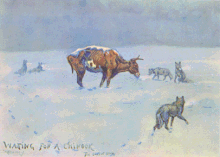
Waiting for a Chinook by C.M. Russell. Overgrazing and harsh winters were factors that brought an cease to the age of the open range

Introduction of barbed wire fences marked the closure of the open range.
Expansion of the cattle industry resulted in the demand for additional open range. Thus many ranchers expanded into the northwest, where there were still large tracts of unsettled grassland. Texas cattle were herded northward, into the Rocky Mountains and Dakotas.[20] In 1866, Nelson Story used the Bozeman Trail to successfully drive virtually thou caput of Longhorn into the Gallatin Valley of Montana.[21] Individual cattle barons such as Conrad Kohrs built upward significant ranches in the northern Rockies. In 1866, Kohrs purchased a ranch near Deer Social club, Montana[22] from former Canadian fur trader Johnny Grant. At its elevation, Kohrs owned 50,000 head of cattle, grazing on 10 meg acres (4 one thousand thousand hectares) spread across four states and two Canadian Provinces, and shipped 10,000 caput annually to the Union Stock Yards in Chicago.
Later, however, continued overgrazing, combined with drought and the exceptionally severe winter of 1886–1887 wiped out much of the open range cattle concern in Montana and the upper Great Plains. Following these events, ranchers began to use barbed wire to enclose their ranches and protect their ain grazing lands from intrusions by others' animals.
In the 1890s, herds were still occasionally driven from the Panhandle of Texas to Montana. All the same, railroads had expanded to cover most of the nation, and meat packing plants were congenital closer to major ranching areas, making long cattle drives to the railheads unnecessary.[23]
Modernistic cattle drives [edit]

Modern mean solar day cattle drive, 1987
Smaller cattle drives connected at least into the 1940s, equally ranchers, prior to the development of the modernistic cattle truck, all the same needed to herd cattle to local railheads for transport to stockyards and packing plants. Today, cattle drives are primarily used to round up cattle within the boundaries of a ranch and to motion them from one pasture to another, a process that more often than not lasts at most a few days. Considering of the significance of the cattle drive in American history, some working ranches have turned their seasonal drives into tourist events, inviting guests in a manner alike to a guest ranch to participate in moving the cattle from one feeding ground to the adjacent. While horses are nevertheless used in many places, especially where there is rough or mountainous terrain, the all-terrain vehicle is besides used. When cattle are required to motility longer distances, they are shipped via truck.
Events intended to promote the western lifestyle may contain cattle drives. For instance, the Great Montana Centennial Cattle Drive of 1989 historic the land of Montana'south centennial and raised money for a college scholarship fund as 2,400 people (including some working cowboys), 200 wagons and 2,800 cattle traveled fifty miles in six days from Roundup to Billings forth a major highway.[24] Similar drives have been sponsored since that fourth dimension.
Cowboy culture [edit]

Theodore Roosevelt (shown on horseback,1898) helped popularize the image of the American cowboy through his writings.
The cowboy's distinctive working gear, most of it derived from the Mexican vaquero, captured the public image. High-crowned cowboy hat, high-heeled boots, leather chaps, pistol, rifle, lariat, and spurs were functional and necessary in the field, and fascinating on the moving picture screen. Increasingly the public identified the cowboy with courage and devotion to duty, for he tended cattle wherever he had to go, whether in bogs of quicksand; swift, flooding rivers; or seemingly inaccessible castor. He rode with lightning and blizzard, ate hot summertime sand, and was burned by the sun. Theodore Roosevelt conceptualized the herder as a phase of civilization distinct from the sedentary farmer—a classic theme well expressed in the 1944 Broadway hitting "Oklahoma!"—Roosevelt argued that the manhood typified by the cowboy—and outdoor action and sports generally—was essential if American men were to avert the softness and rot produced by an piece of cake life in the metropolis. The cow towns along the trail were notorious for providing liquor to the cowboys; they normally were not allowed to drinkable on the trail itself.[25]
Paradigm and retention [edit]
During iii decades it had moved over ten million cattle and 1 million range horses, stamped the entire West with its character, given economic and personality prestige to Texas, made the longhorn historic, glorified the cowboy over the globe, and endowed America with its most romantic tradition relating to whatsoever occupation.
The all-time known writers of the era include Theodore Roosevelt, who spent much of his inheritance ranching in the Dakotas in the 1880s, Will Rogers, the leading humorist of the 1920s, and Indiana-born Andy Adams (1859–1935), who spent the 1880s and 1890s in the cattle industry and mining in the Great Plains and Southwest. When an 1898 play's portrayal of Texans outraged Adams, he started writing plays, short stories, and novels drawn from his own experiences. His The Log of a Cowboy (1903) became a classic novel almost the cattle business concern, particularly the cattle drive. It described a fictional drive of the Circle Dot herd from Texas to Montana in 1882, and became a leading source on cowboy life; historians retraced his path in the 1960s, confirming his basic accuracy. His writing is acclaimed and criticized for both its fidelity to truth and lack of literary qualities.[26]
Cattle drives on television and film [edit]
Cattle drives were a major plot element of many Hollywood films and television shows, particularly during the era when westerns were popular. One of the most famous movies is Scarlet River (1948) directed past Howard Hawks, and starring John Wayne and Montgomery Clift. Similar many such films, Reddish River tended to exaggerate the dangers and disasters of cattle driving. More recently, the motion-picture show Metropolis Slickers (1990) was about a invitee ranch-based cattle drive. In the 1958 film Cowboy, Glenn Ford stars every bit a hard-living trail boss with Jack Lemmon every bit a citified "tenderfoot" who joins the drive.
The long running Goggle box show Rawhide (1959–1965), starring Eric Fleming and Clint Eastwood, dealt with drovers taking 3000 head along the Sedalia trail from San Antonio, Texas to the railhead at Sedalia. Episode four of the 1970s miniseries Centennial, titled The Longhorns, featured a cattle drive from central Texas to northeastern Colorado. The 1980s miniseries Lonesome Dove, based on a Pulitzer Prize winning novel of the same name, centered on a cattle drive from South Texas to Montana.
Run into also [edit]
- Cattle drive (worldwide focus)
- Cowboy
- Drover (Australian)
- Ranch
- Station (Australian agriculture)
References [edit]
- ^ a b c d e Skaggs, Jimmy M. The Cattle-Trailing Industry: Betwixt Supply and Demand, 1876–1890 (University Printing of Kansas, 1973)[ page needed ]
- ^ Malone, pp. 46–47
- ^ Post Malone, p. 52
- ^ Malone, pp. 48–50
- ^ Rosenthal, Leon Southward. (1963). A History of Philadelphia's Academy City. Philadelphia: University Urban center Corporation.
- ^ a b Gaylord, Kristina. "Chisholm Trail". Chisholm Trail.
- ^ a b Donald E. Worcester, "Longhorn cattle," Handbook of Texas Online (2008)
- ^ Chuck Veit (2006). "The Keen Navy Cattle Drive of '62". Naval History. 20 (3): 24–31. ISSN 1042-1920.
- ^ Skaggs, Jimmy M. "CATTLE Trailing". Handbook of Texas Online. Texas Country Historical Association. Retrieved March 22, 2013.
- ^ Malone, p. 6
- ^ Malone, pp. 38–39
- ^ Douglas N. Travers (2001). "The Corking Chihuahua Cattle Drive of 1868". Journal of Big Bend Studies. thirteen: 85–105. ISSN 1058-4617.
- ^ Lawrence O. Christensen, Dictionary of Missouri biography (1999) p. 531
- ^ Malone, p. 40
- ^ Robert R. Dykstra (1983). The Cattle Towns. U of Nebraska Press. pp. 62–. ISBN978-0-8032-6561-5 . Retrieved ii Jan 2012.
- ^ Charles Phillips and Alan Axelrod, Encyclopedia of the American Due west (1996) vol. ane p. 275
- ^ Donald Due east. Worcester: "Chisholm Trail," Handbook of Texas Online (2008)
- ^ Donald E. Worcester, The Chisholm Trail (University of Nebraska Press, 1980).
- ^ Robert R. Dykstra (1983). The Cattle Towns. U of Nebraska Press. pp. 143–. ISBN978-0-8032-6561-v . Retrieved 2 January 2012.
- ^ Malone, p. 76
- ^ Kennedy, Michael Due south. (1964). "Tall in the Saddle-Commencement Trail Drive to Montana Territory". Cowboys and Cattlemen-A Roundup from Montana The Magazine of Western History. New York: Hastings Business firm Publishing. pp. 103–111.
- ^ History of Deer Lodge, Montana. www.powellpost.com
- ^ Malone, p.79
- ^ Montana: A Historic Load of Bull. Time. September 18, 1989
- ^ Raymond B. Wrabley, Jr. (2007). "Drunk Driving or Dry Run? Cowboys and Alcohol on the Cattle Trail". Kansas History. 30 (1): 36–51. ISSN 0149-9114.
- ^ Adams, Andy. The Log of a Cowboy: A Narrative of the One-time Trail Days (1903)
Bibliography [edit]
- Malone, John William. An Album of the American Cowboy. New York: Franklin Watts, Inc., 1971. ISBN 9780531015124
Further reading [edit]
- Allmendinger, Blake. The Cowboy: Representations of Labor in an American Piece of work Culture. (1992). 213 pp.
- Alonzo, Armando C. Tejano Legacy: Rancheros and Settlers in South Texas, 1734–1900 (1998) online edition
- Atherton, Lewis Due east. The Cattle Kings (1961), influential interpretive study
- Carlson, Paul H., ed. The Cowboy Way: An Exploration of History and Culture. (2000). 236 pp. online edition
- Carlson, Paul Howard, ed. The Cowboy Way: An Exploration of History and Civilization (2000) excerpt and text search
- Cattle Raisers Association of Texas. History of the Cattlemen of Texas. (1914, reprint 1991). 350 pp.
- Clayton, Lawrence; Hoy, Jim; and Underwood, Jerald. Vaqueros, Cowboys, and Buckaroos. (2001) 274 pp.
- Collins, Hubert E. Storm and Stampede on the Chisholm (1928, reprint 1998) online edition
- Corkin, Stanley. "Cowboys and Free Markets: Post-World War Two Westerns and U.S. Hegemony," Cinema Periodical, Vol. 39, No. 3 (Spring, 2000), pp. 66–91, focus on Howard Hawks's "Ruddy River" (a cattle drive) and John Ford'due south "My Darling Clementine" (on Tombstone); in JSTOR
- Corkin, Stanley. Cowboys as Cold Warriors: The Western and U.S. History. (2004). 273 pp.
- Dale E. E. The Range Cattle Industry (1930)
- Dary, David. Cowboy Civilization: A Saga of Five Centuries. (1981). 336 pp. excerpt and text search
- Dippie, Brian W., ed. Charlie Russell Roundup: Essays on America'southward Favorite Cowboy Artist. (1999). 328 pp.
- Dobie, J. Frank Moo-cow People (1964) excerpt and text search
- Draper, Robert. "21st -Century Cowboys: Why the Spirit Endures." National Geographic, December 2007, pp. 114–135
- Dykstra, Robert R., and Jo Ann Manfra. "The Circle Dot Cowboys at Contrivance City: History and Imagination in Andy Adams's The Log of a Cowboy," Western Historical Quarterly 33 (2002): 19–xl,
- Evans, Simon; Carter, Sarah; and Yeo, Nib, eds. Cowboys, Ranchers, and the Cattle Business: Cross-Border Perspectives on Ranching History. (2000). 232 pp.
- Frantz, Joe B., and Julian E. Choate. The American Cowboy, The Myth and the Reality ( 1955)
- Gard, Wayne. The Chisholm Trail (1969), the standard scholarly history
- Hawks, Howard, director. Ruby-red River (1948), influential Hollywood motion picture starring John Wayne and Montgomery Clift
- Iverson, Peter. When Indians Became Cowboys: Native Peoples and Cattle Ranching in the American Westward (1997) excerpt and text search
- Jordan, Terry. North American Cattle-Ranching Frontiers: Origins, Diffusion, and Differentiation (1993) online edition
- Jordan, Terry. Trails to Texas: Southern Roots of Western Cattle Ranching (1981)
- Keese, M. Pomeroy. "Beef," Harper's new monthly magazine. July 1884 vol. 69, Issue 410 pp. 292–302 online, strong on economic themes
- Lanning, Jim and Lanning, Judy, eds. Texas Cowboys: Memories of the Early Days. (1984). 233 pp.
- Logsdon, Guy, ed. "The Whorehouse Bells Were Ringing" and Other Songs Cowboys Sing. (1989). 388 pp.
- Massey, Sara R. Texas Women on the Cattle Trails (2006) excerpt and text search
- Massey, Sara R., ed. Blackness Cowboys of Texas. (2000). 361 pp. excerpt and text search
- McCoy, Joseph M. Historic Sketches of the Cattle Trade of the Due west and Southwest (1874, reprint 1940). McCoy opened the first railhead to big shipments of Texas cattle in 1867.
- Osgood, Eastward. S. The Day of the Cattleman. (1929) excerpt and text search
- Ridings, S.P. Chisholm Trail (1936)
- Rollins, Philip Ashton. The Cowboy: An Unconventional History of Civilization on the Quondam-Fourth dimension Cattle Range. (1922, reprint 1997). 402 pp.
- Rossel, John. "The Chisholm Trail," Kansas Historical Quarterly (1936) Vol. 5, No. 1 pp 3–14 online edition
- Saunders, George W. et al. The Trail Drivers of Texas, ed. by J. Marvin Hunter (1925, reprint 1985), by far the most valuable source for individual experiences on the long drives. excerpts and text search
- Vicious, William W., Jr. The Cowboy Hero: His Image in American History and Culture. (1979). 179 pp.
- Skaggs, Jimmy. The Cattle Trailing Industry: Between Supply and Demand, 1866–1890 (1973), pathbreaking economical study
- Slatta, Richard W. Comparison Cowboys and Frontiers. (1997). excerpt and text search
- Slatta, Richard W. Cowboys of the Americas. (1990).
- Smith, Andrew Brodie. Shooting Cowboys and Indians: Silent Western Films, American Culture, and the Nascence of Hollywood. (2003). 230 pp.
- Stanley, David and Thatcher, Elaine, eds. Cowboy Poets and Cowboy Poetry. (2000)
- Streeter, Floyd "Texas Cattle Drives to a Ranch on Bluff Creek" Capt. Eugene B. Millett "Wichita State Library" MS 74-31
- Tompkins, Jane. West of Everything: The Inner Life of Westerns. (1992).
- Vernam, Glenn R. Man on Horseback New York: Harper & Row 1964
- Walker, Don D. Clio'southward Cowboys: Studies in the Historiography of the Cattle Trade. (1981).
- Webb, Walter P. The Great Plains (1931); Study Guide [ permanent dead link ]
External links [edit]
- Encyclopedia of Oklahoma History and Civilization – Cattle Drives
- Illinois Cattle Drives
- Shawnee Trail
- Oklahoma Digital Maps: Digital Collections of Oklahoma and Indian Territory
Source: https://en.wikipedia.org/wiki/Cattle_drives_in_the_United_States
Belum ada Komentar untuk "what two factors led to the end of the long drives"
Posting Komentar