What was the topic of the argument that led to the Great Schism?
Jul 16, 1054 CE: Neat Schism
Jul xvi, 1054 CE: Keen Schism
On July 16, 1054, Patriarch of Constantinople Michael Cerularius was excommunicated, starting the "Cracking Schism" that created the ii largest denominations in Christianity—the Roman Cosmic and Eastern Orthodox faiths.
Expansion of Christianity
The Smashing Schism split the master faction of Christianity into two divisions, Roman Cosmic and Eastern Orthodox. Today, they remain the two largest denominations of Christianity.
Map from Atlas of the Historical Geography of the Holy Land
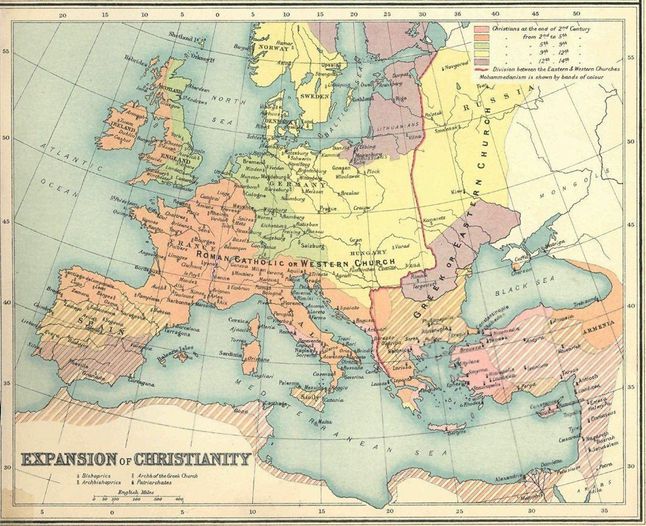
On July 16, 1054, Patriarch of Constantinople Michael Cerularius was excommunicated from the Christian church based in Rome, Italia. Cerularius'due south excommunication was a breaking indicate in long-rising tensions between the Roman church building based in Rome and the Byzantine church based in Constantinople (now called Istanbul). The resulting split divided the European Christian church into ii major branches: the Western Roman Catholic Church and the Eastern Orthodox Church building. This split up is known as the Swell Schism, or sometimes the "E-Westward Schism" or the "Schism of 1054." The Great Schism came about due to a complex mix of religious disagreements and political conflicts. One of the many religious disagreements between the western (Roman) and eastern (Byzantine) branches of the church building had to practice with whether or not it was acceptable to use unleavened bread for the sacrament of communion. (The west supported the do, while the e did not.) Other objects of religious dispute include the exact wording of the Nicene Creed and the Western belief that clerics should remain celibate. These religious disagreements were fabricated worse past a diverseness of political conflicts, peculiarly regarding the power of Rome. Rome believed that the pope—the religious leader of the western church—should have authority over the patriarch—the religious authority of the eastern church. Constantinople disagreed. Each church recognized their own leaders, and when the western church eventually excommunicated Michael Cerularius and the entire eastern church. The eastern church building retaliated past excommunicating the Roman pope Leo III and the Roman church with him. While the two churches have never reunited, over a thousand years later on their split, the western and eastern branches of Christianity came to more peaceable terms. In 1965, Pope Paul Six and Patriarch Athenagoras I lifted the longstanding mutual excommunication decrees made by their respective churches. Today, the two branches of Christianity remain distinct expressions of a similar faith. Roman Catholicism is the unmarried largest Christian denomination, with more than than a billion followers around the globe. Eastern Orthodoxy is the second-largest Christian denomination, with more than 260 million followers. Eastern Orthodoxy includes national churches, such as the Greek Orthodox Church and Russian Orthodox Church.
authority
Noun
person or organization responsible for making decisions.
Cosmic
Adjective
having to practise with the Christian denomination with the Pope as its leader.
ceremony
Noun
activities to celebrate or commemorate an event.
Christianity
Noun
religion based on the teachings of Jesus of Nazareth.
communion
Noun
Christian sacrament commemorating the expiry of Jesus Christ with staff of life and vino.
disharmonize
Noun
a disagreement or fight, usually over ideas or procedures.
denomination
Noun
branch of a church or larger spiritual faith.
Eastern Orthodox
Noun
loose affiliation of several Christian denominations (including Russian Orthodox, Greek Orthodox, etc.) which follow early church bureaucracy.
anathematize
Verb
to cut off or expel from a church.
faction
Noun
group inside a larger group.
patriarch
Noun
highest-ranking bishop in Eastern Orthodox, Oriental Orthodox, the Catholic Church, and the Assyrian Church of the East.
pope
Noun
leader of the Cosmic Church.
applied
Adjective
useful or piece of cake to utilize.
schism
Noun
split or separation.
sever
Verb
to dissever or cut away.
spiritual
Adjective
having to do with faith or faith.
unleavened
Adjective
having to do with baked appurtenances lacking a substance that causes them to expand or rising.
More Dates in History
Source: https://www.nationalgeographic.org/thisday/jul16/great-schism/
Belum ada Komentar untuk "What was the topic of the argument that led to the Great Schism?"
Posting Komentar